Three lowest totals for Afghanistan in Test cricket ft. India’s Dominance
The Steep Learning Curve of Test Cricket
The Afghanistan cricket team has undoubtedly captured the world’s imagination, producing exceptionally talented players and defeating formidable opponents with a fearless, aggressive style of play. Their rise in white-ball cricket has been meteoric, earning them global respect. However, Test cricket remains the ultimate litmus test for any nation, a format that demands technical precision, mental fortitude, and long-term endurance. Afghanistan has learned this lesson the hard way on several occasions.
When facing the most seasoned giants of the sport, particularly India, Afghanistan’s batting lineup has often found itself under immense pressure. It is no secret that their most challenging moments in the format have come against the Indian side. The Three lowest totals for Afghanistan in Test cricket ft. India’s Dominance serve as a poignant reminder of the significant gap in experience and the unrelenting intensity that characterizes high-level international red-ball cricket.
3. 112 vs India, Mullanpur, 2026
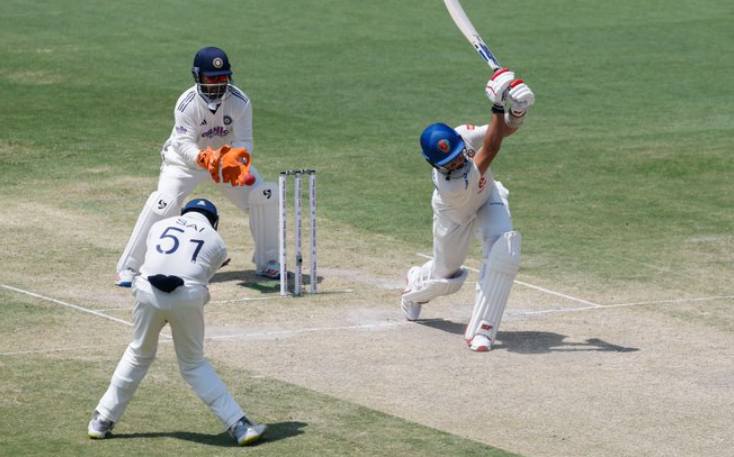
The recent one-off Test in Mullanpur provided yet another masterclass by the Indian team. Dominating with the bat, India posted a massive 564/8, spearheaded by centuries from Shubman Gill and KL Rahul. For the visitors, the task of chasing such a colossal total quickly devolved into a struggle for survival.
Afghanistan’s batters were unable to withstand the multifaceted Indian spin attack. Wickets fell at regular intervals as the lineup failed to build sustainable partnerships. Sediqullah Atal provided a glimmer of resistance with a respectable 42, and Rahmanullah Gurbaz contributed a brisk 24, but the middle and lower order crumbled under the weight of sustained pressure.
Washington Sundar was the standout performer with the ball, dismantling the order with four crucial wickets. He was ably supported by the guile of Kuldeep Yadav and the relentless accuracy of debutant Manav Suthar. Ultimately, after being dismissed for 152 in their first innings, Afghanistan managed only 112 in their second, resulting in a crushing innings-and-300-run defeat.
2. 109 vs India, Bengaluru, 2018
To understand the history of Afghanistan’s Test journey, one must look back to their inaugural appearance in 2018 at Bengaluru. While the atmosphere was electric and the occasion historic, the game served as a harsh introduction to the realities of Test cricket. India asserted their dominance early, forcing Afghanistan to follow on after a significant first-innings deficit.
The second innings proved to be a difficult ordeal as the Indian bowlers combined pace and spin to stifle any scoring opportunities. Ravichandran Ashwin was particularly lethal, bowling with exquisite control and extracting turn from the surface. Supported by the sharp accuracy of Ravindra Jadeja and the hostile spells from Ishant Sharma, the Indian attack proved too sophisticated for the Afghan lineup, leading to an eventual collapse for 109 runs.
1. 103 vs India, Bengaluru, 2018
The ignominy of their lowest-ever Test total occurred during that same inaugural Test in Bengaluru. Having already conceded a mountain of runs, with India posting 474 in the first innings, the Afghan batters stepped onto the field under immense psychological pressure.
The innings never gathered momentum. Hashmatullah Shahidi stood tall for a brief period, demonstrating defensive technique and concentration to score 36 runs, but he found little support at the other end. Ravindra Jadeja utilized his left-arm spin to devastating effect, claiming four wickets, while Umesh Yadav’s raw pace decimated the tail to secure three vital scalps.
In just 38.4 overs, the innings concluded at 103. This remains the lowest total in Afghanistan’s Test history, marking the most difficult day the side has faced in the longest format. While these statistics are sobering, they represent a vital chapter in the team’s growth, highlighting the immense strides they must take to compete with the world’s best on the biggest stages.